Financial modelling and model audit
Models built to be operated by someone else, because that is the only test that matters.
The problem with most models
Most financial models are written to be finished rather than used. They work on the day they are delivered, in the hands of the person who built them, for the exact question that was asked. Three months later somebody needs to change one assumption and nobody dares touch the file.
That is a design failure. The modelling was usually fine. A model only its author can operate has failed at the thing it was for.
Before delivery, someone who has never opened the file changes a headline assumption and traces the effect to the outputs, unaided. If they cannot, the model is not finished.
What the work looks like.
An assumption, a formula, a decision. This fictional extract shows how they connect and where we would focus a review.
Explore the figures in the model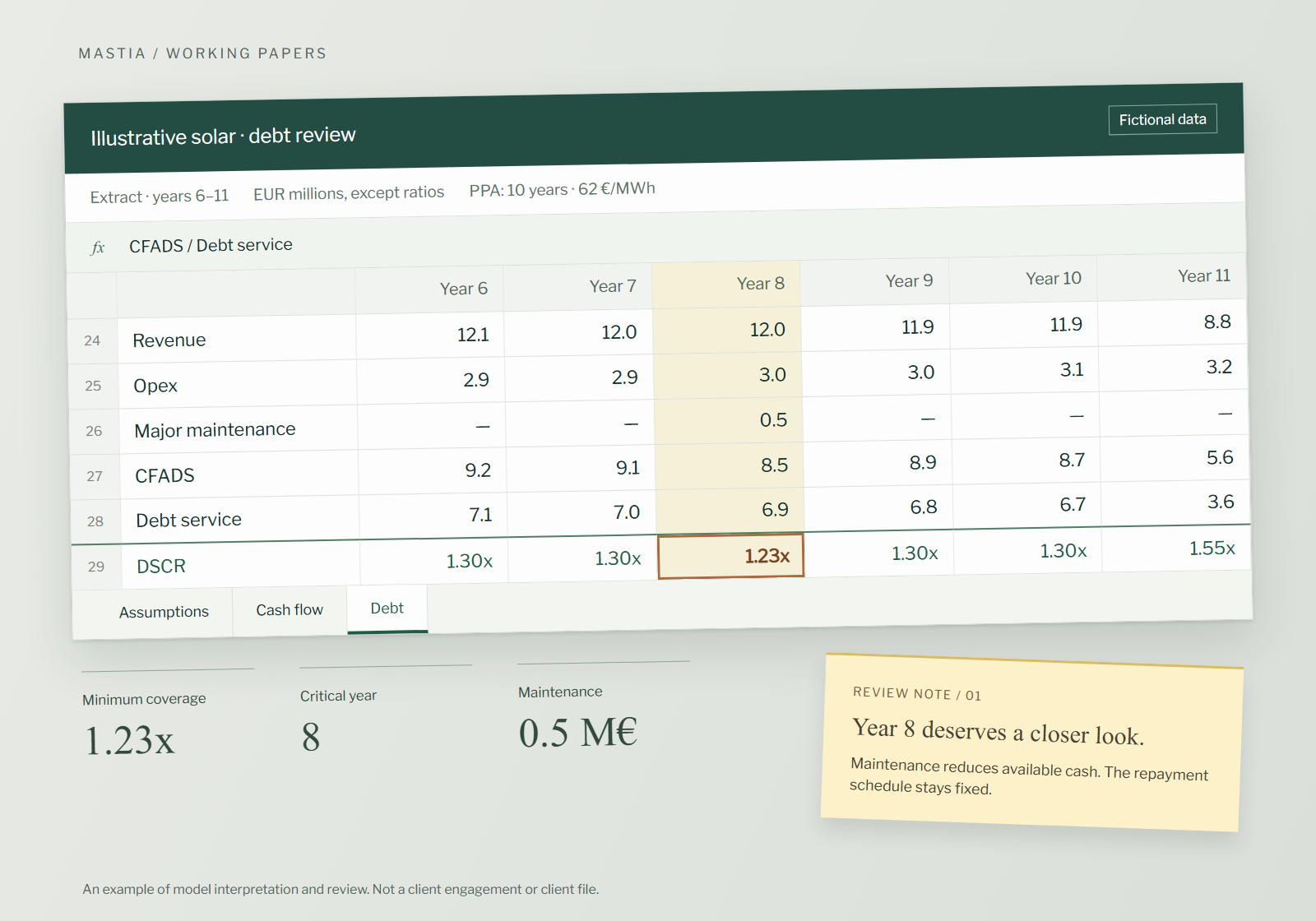 View the full-size image ↗
- 01
Find the assumptions.
Prices, costs and the contract term make the starting point visible.
- 02
Follow the calculations.
From revenue to available cash, and from cash to debt service.
- 03
Understand the review.
Identifying the tight year and its cause helps decide what to examine next.
Where a model engagement starts
Build
A model from a blank sheet, sized to the decision rather than to the number of tabs anyone expects to see.
Rebuild
An inherited model nobody trusts, rebuilt to the standard, with a reconciliation showing every difference and why it exists.
Audit
An independent review of someone else's model, with findings ranked by what they would cost if left alone.
What a review looks for
Two lists. The first is spreadsheet integrity, which is where the unbounded risks live. The second is transaction logic, which is where the arguments happen.
| Area | What it looks like | Why it matters |
|---|---|---|
| Row consistency | One period in a twenty-five-year row differs from its neighbours | Invisible and unbounded. The defect most likely to be material and least likely to be found by reading |
| Structural integrity | Circularity, an assumption hard-coded inside a formula, broken links | Silent divergence the moment an assumption changes |
| Reconciliation | Balance sheet balances, cash flow ties to the movement in cash | A rounding plug that has become material makes the statements tie for the wrong reason |
| Coverage definitions | DSCR defined one way on the summary sheet and another in the calculation | Headroom overstated wherever the looser definition is used |
| Indexation | Inflation applied off the wrong base year | Compounds silently across the whole term |
| Sensitivity mechanics | A scenario switch that changes revenue but not the cost base | Sensitivities that understate the downside, which is the only direction that matters |
| Tax and timing | Loss carry-forwards, depreciation on book rather than tax life, payment lags | Moves CFADS in the years the covenant is tightest |
| Degradation | Output degradation compounded on nameplate rather than on prior-year output | Understates the decline over a twenty-five-year term |
| Debt mechanics | Sculpting convergence, drawdown logic, day count and stub period at first drawdown, DSRA look-forward window | Changes minimum DSCR at exactly the point the covenant is tested |
| Solver staleness | An iteration block solved against inputs that have since changed | Every check row reads pass while the answer is stale |
Findings arrive as a ranked list with the effect of each one on the numbers that matter, not as a spreadsheet of every cosmetic inconsistency in the file. The point is to know what to fix first.
Have it read before it carries the decision
If a real commitment depends on the file and nobody independent has read it, that is usually reason enough.